
Explore Expert Insights, Strategic Research, and Global Thought Leadership
Clear thinking for complex systems.
Our publications translate systems complexity into actionable insight—through original research, strategic frameworks, and global roundtable takeaways.
Featured
Highlighted insights from our latest research and thought leadership.

The Badge and the Algorithm: Human Judgment, Institutional Accountability, and the Future of Trust in Public Safety AI examines how artificial intelligence is reshaping public safety and civic governance faster than many institutions have been able to develop the governance frameworks and safeguards needed to guide its use. This complete edition brings together two companion works: “The Badge and the Algorithm,” which examines how AI can be adopted responsibly in public safety, and “When Systems Fail,” which addresses what leadership, accountability, and trust restoration require when an AI system causes harm.
Drawing on more than three decades of public safety leadership, including the author’s experience leading a major American police department through one of the most consequential and closely watched periods in modern policing, the paper argues that human judgment must remain accountable for every AI-assisted decision capable of affecting a person’s liberty, property, or dignity. Part 1 establishes the Three Pillars of Responsible AI Adoption: human judgment at every liberty-affecting decision point, transparent governance that communities can understand and contest, and trust as the outcome by which every adoption decision is measured. It also makes the case for redeploying officers toward high-judgment, relationship-centered work.
Part 2 turns to the question of what happens when those safeguards fail. It presents a four-stage framework for restoring trust after an AI failure: Honest Acknowledgment, Transparent Accountability, Structural Repair, and Community Restoration. Together, the framework provides institutions with a practical approach to confronting harm, tracing responsibility, repairing governance failures, and sustaining engagement with affected communities.
Drawing on governance standards and lessons from across the globe, including OECD and G20 AI principles and approaches to community participation and data governance across Europe, Africa, and the Asia-Pacific, the paper positions responsible AI adoption as an international governance challenge rather than a solely US concern. Ultimately, it argues that AI must remain governed by principles that protect human dignity, institutional accountability, and public trust. As technological capability continues to expand, the most essential infrastructure in public safety remains unchanged: public trust.


From Disclosure to the Cost of Capital: How EU Sustainability Regulation Is Reshaping Board Oversight examines how Europe’s expanding sustainability regulatory framework is changing the relationship between corporate reporting, financial risk, and governance. What began largely as a transparency agenda has developed into a broader system in which sustainability considerations increasingly influence risk assessment, financing conditions, and the responsibilities of corporate supervisory boards.
The paper traces the evolution of key regulatory instruments, including the EU Taxonomy, Corporate Sustainability Reporting Directive (CSRD), European Sustainability Reporting Standards (ESRS), Corporate Sustainability Due Diligence Directive (CSDDD), and European Banking Authority (EBA) guidelines on ESG risks. It also examines the recent Omnibus reforms and their implications for the scope and implementation of sustainability requirements. Against this regulatory backdrop, the paper explores how ESG risks are becoming increasingly embedded in financial risk management and how this shift may affect capital allocation and the cost of financing for different business models.
The paper ultimately considers what this transformation means for corporate governance. As sustainability regulation moves beyond disclosure toward risk management and financial decision-making, supervisory boards face a growing responsibility to oversee ESG data, assess sustainability-related risks, and integrate longer-term environmental and social considerations into corporate strategy. The paper positions this evolution not simply as an expansion of compliance obligations, but as a shift in how sustainability becomes relevant to corporate risk, capital, and long-term value creation.
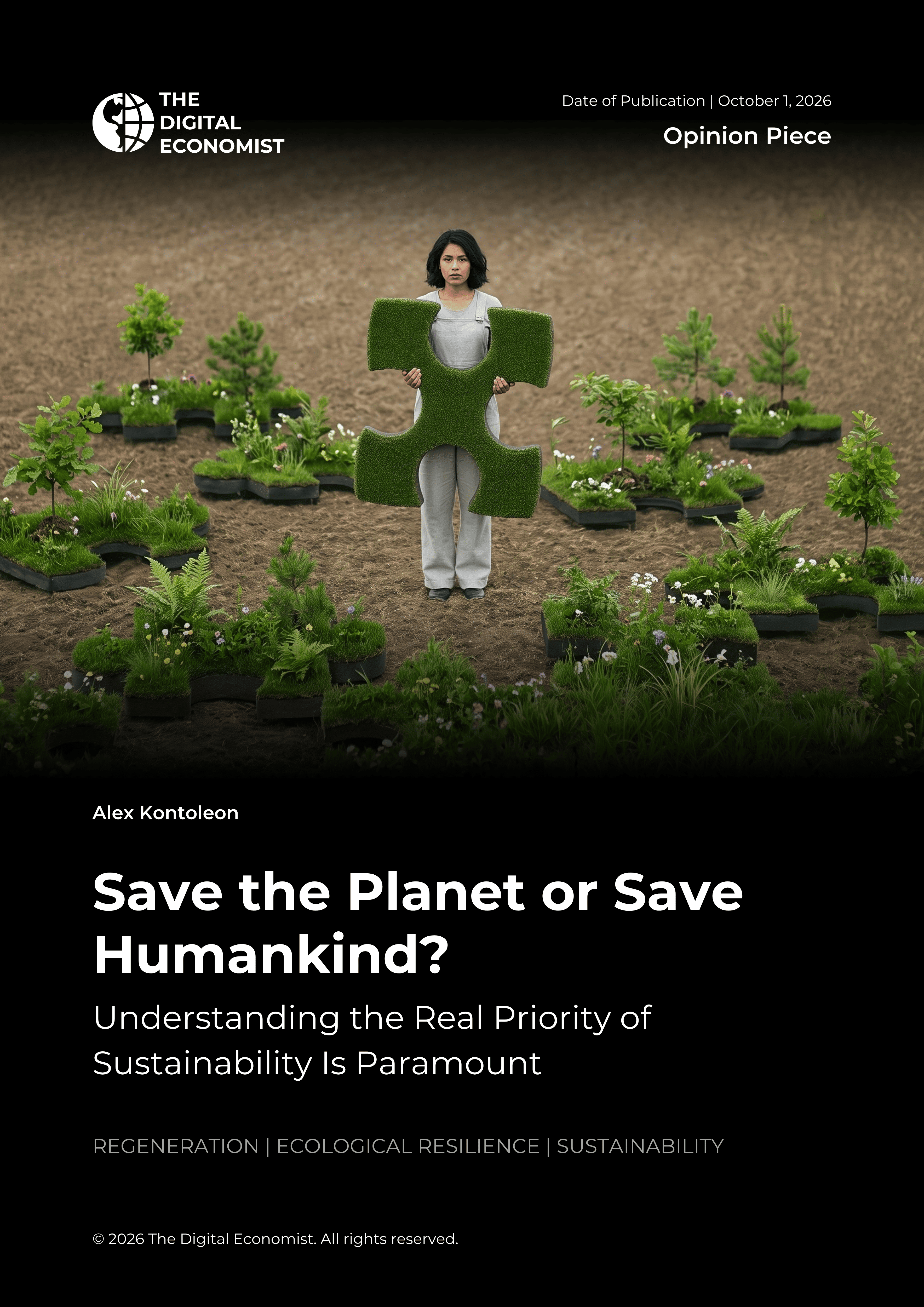
Save the Planet or Save Humankind? examines the paradox at the heart of modern sustainability: humanity has achieved unprecedented levels of prosperity, longevity, and technological advancement, yet these gains have come at an increasing ecological cost. The paper explores why decades of sustainability efforts have struggled to reverse environmental degradation and argues that the challenge may lie not only in what we are doing, but in how we have framed the problem.
The paper examines the assumptions underlying conventional sustainability thinking, including the tendency to view environmental decline through a linear, extractive model of resource use. Drawing on the planetary boundaries framework, regenerative economics, ecological systems thinking, and research on circular and nature-positive approaches, it explores the distinction between sustaining existing systems and actively regenerating the conditions that support human prosperity. It argues that the planet itself does not need to be “saved”; rather, the focus should be on maintaining the ecological conditions that make human life, abundance, and continued prosperity possible.
The paper ultimately calls for a new alignment between economic activity and the regenerative processes of the natural world. Rather than framing sustainability as a moral obligation or a choice between prosperity and the planet, it positions regeneration as the next evolution of sustainability—one that aligns economic incentives, long-term resilience, and human prosperity with the ecological systems on which they depend.
All Article





All Videos
Join our newsletter
Subscribe to our newsletter
Get the latest updates from The Digital Economist

One World Trade Center, 85th floor, New York City, NY 10007
1717 N St NW, Washington, DC 20036
info@thedigitaleconomist.com





One World Trade Center, 85th floor, New York City, NY 10007
1717 N St NW, Washington, DC 20036
info@thedigitaleconomist.com