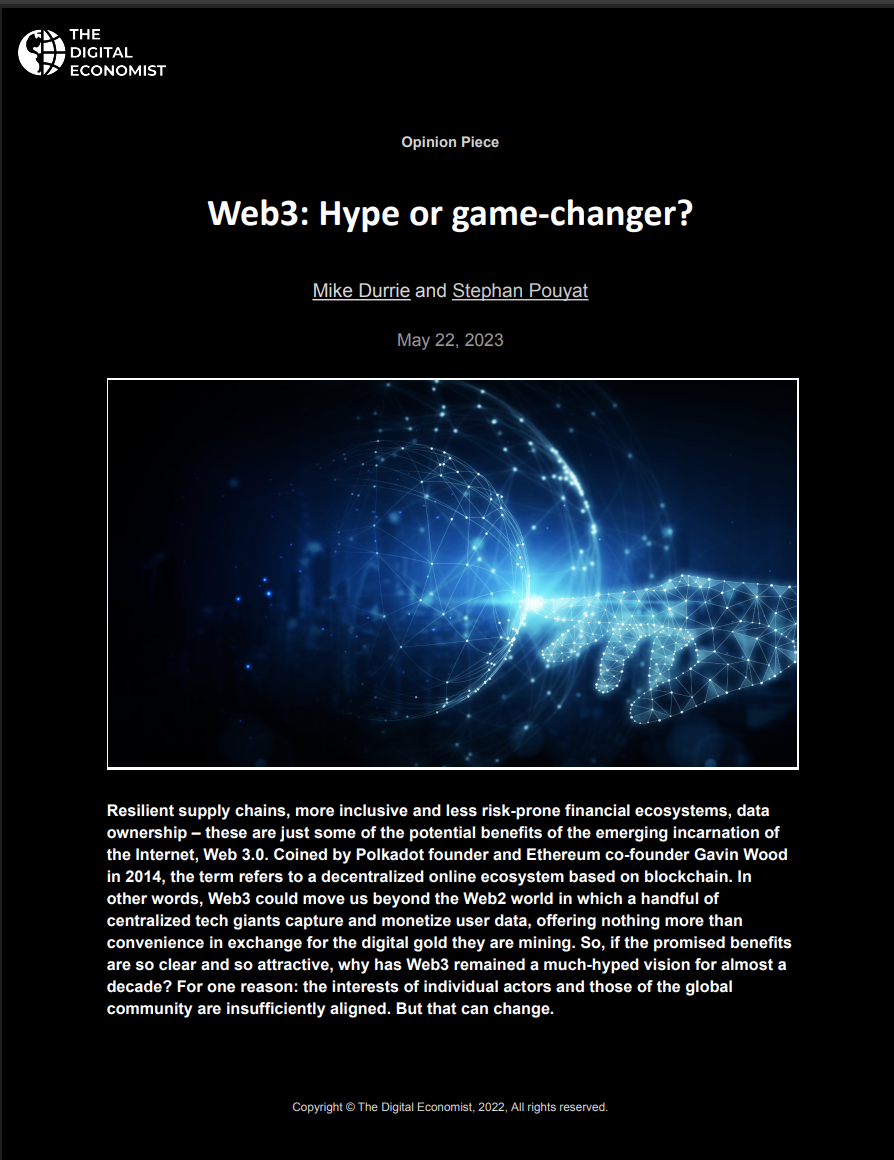
Web3 represents a potential shift in the architecture of the internet, moving from centralized platforms toward decentralized, blockchain-based ecosystems where data ownership, transparency, and user participation are reconfigured. Web3: Hype or Game-Changer? examines whether this emerging paradigm can meaningfully address structural inefficiencies in current digital, financial, and economic systems. While the promise of Web3 includes more resilient supply chains, inclusive financial infrastructure, and user-controlled data, the paper highlights that progress has been constrained by misaligned incentives between individual actors and broader societal interests.
The paper explores practical applications of Web3 across key domains, including supply chains, financial systems, and energy infrastructure. It demonstrates how the integration of distributed ledger technology with complementary systems such as AI, IoT, and real-time data architectures can improve transparency, reduce operational complexity, and enhance system resilience. Case-based insights show how digitized and automated processes can significantly reduce errors, shorten operational cycles, and enable more responsive and adaptive systems. At the same time, the paper examines how Web3-enabled financial infrastructure could address systemic fragilities by enabling real-time data access, standardized processing, and improved regulatory oversight.
The paper outlines the conditions required for Web3 to transition from conceptual promise to systemic impact, emphasizing the importance of decentralized governance models, aligned incentives, and scalable participation frameworks. It highlights tokenization and user participation as mechanisms to overcome the “tragedy of the commons,” enabling shared digital ecosystems where individual and collective interests converge. Ultimately, the paper positions Web3 not as a guaranteed transformation, but as a contingent evolution—one that depends on coordinated action across public and private sectors to build a more transparent, resilient, and human-centered digital economy.