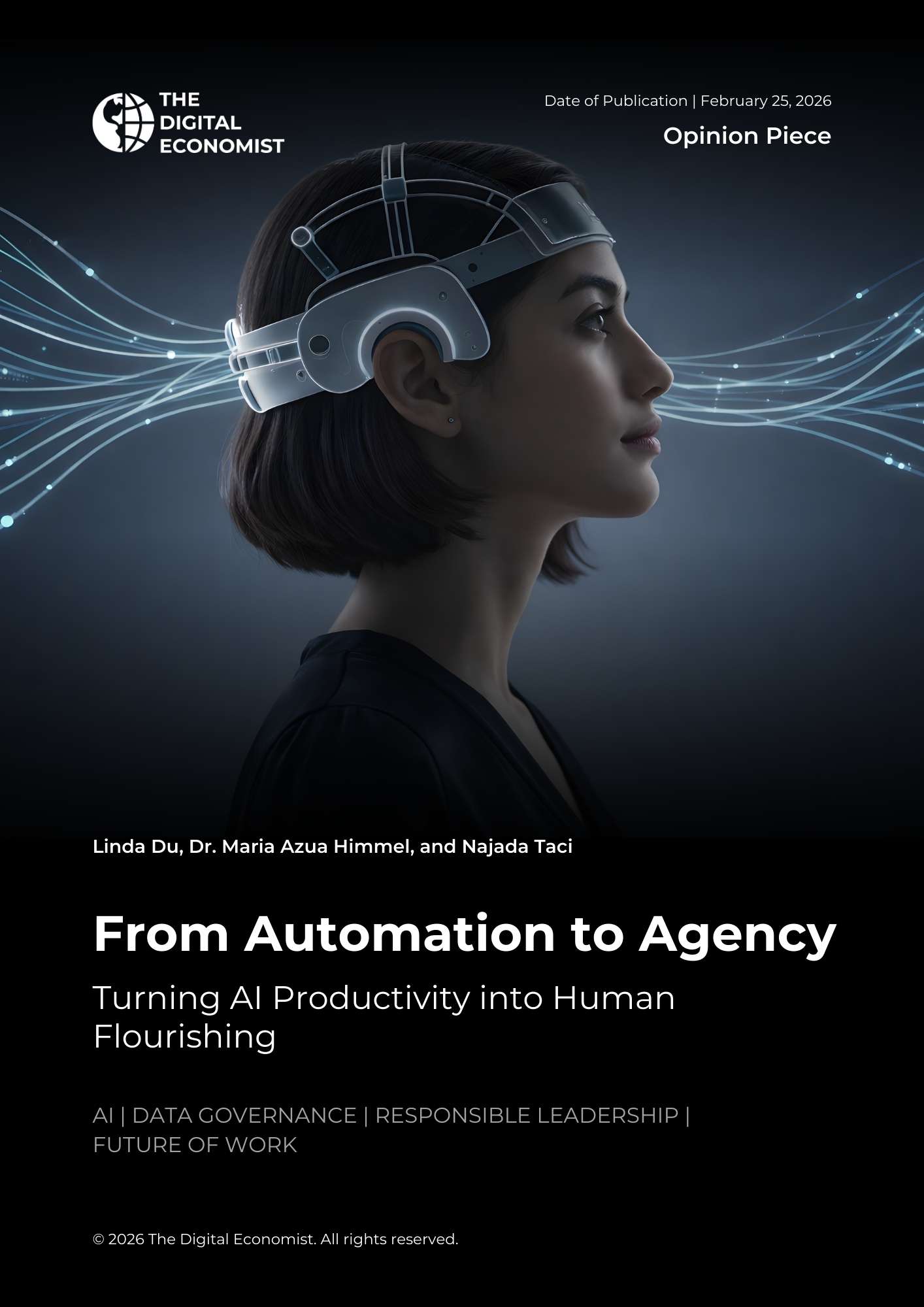
This opinion piece, From Automation to Agency: Turning AI Productivity into Human Flourishing, argues that generative AI represents not just a productivity tool but a governance inflection point for the future of work. Drawing on emerging empirical research, it shows that AI is already reshaping task allocation, wage structures, and regional labor markets—delivering measurable productivity gains, particularly for less-experienced workers, while also altering demand toward roles that combine judgment, coordination, and AI fluency. The central question, the paper contends, is not whether AI increases output, but who benefits from the time and value it frees—and who has a voice in determining how those gains are deployed.
The analysis frames AI adoption as a fork in the road. One pathway treats AI primarily as an optimization engine, intensifying output and embedding algorithmic management more deeply into work. The alternative treats AI as an institutional choice—an opportunity to redesign work around autonomy, competence, and purpose. Evidence from organizational psychology and real-world deployments demonstrates that outcomes depend heavily on governance design: when workers retain discretion, transparency, and participation in system rollout, AI can augment skills and increase job satisfaction; when imposed unilaterally, it risks eroding engagement, well-being, and long-term performance. The paper also highlights the geographic dimension of AI exposure, warning that productivity gains may concentrate in already advantaged metropolitan regions unless matched by targeted investments in infrastructure, reskilling, and worker voice.
Ultimately, the piece positions AI productivity gains as governance choices rather than technological inevitabilities. It advances practical principles for business leaders, policymakers, and individuals—emphasizing co-design of AI systems, reinvestment of efficiency gains into human development, modernization of job-quality metrics, and cultivation of AI literacy and agency skills. The core argument is clear: technological abundance does not automatically translate into human flourishing. Whether AI narrows or widens inequality—and whether work becomes more meaningful or more extractive—will depend on the institutional, organizational, and individual choices that shape its deployment.













.jpg)

.jpg)
.jpg)
.png)