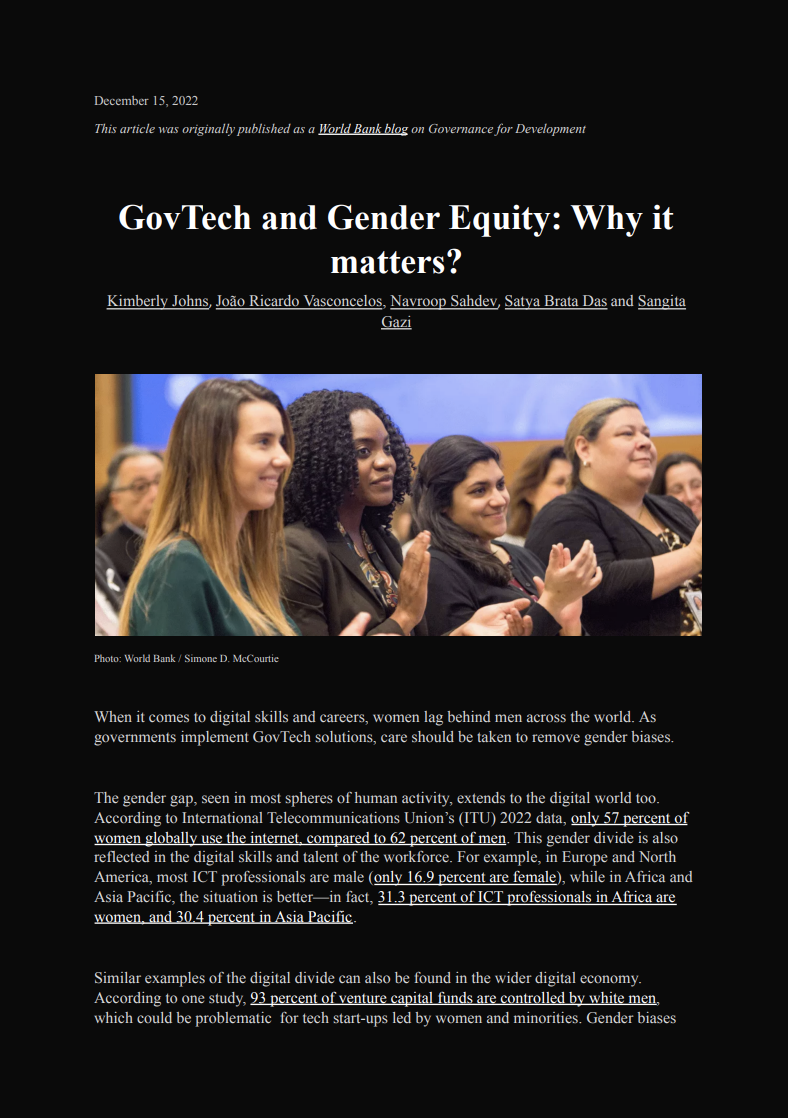
Digital transformation in government is reshaping how public services are designed and delivered, but persistent gender disparities risk reinforcing existing inequalities in the digital economy. GovTech and Gender Equity: Why It Matters examines how gaps in digital access, skills, and workforce representation continue to limit women’s participation in GovTech. Drawing on global data, the paper highlights disparities in internet usage, ICT employment, and access to capital, underscoring how structural biases in both technology systems and labor markets can perpetuate exclusion if left unaddressed.
The paper explores how these gender gaps manifest across public sector systems, from workforce composition to the design of digital services. While women represent a significant share of the public sector workforce, they are disproportionately concentrated in lower-paid roles and underrepresented in decision-making and technical positions. The analysis also highlights risks of algorithmic and systemic bias in digital tools, as well as broader inequities in funding and innovation ecosystems. These dynamics, if uncorrected, can lead to gender-biased outcomes in public service delivery and limit the effectiveness of digital government initiatives.
The paper outlines a policy framework for integrating gender equity into GovTech strategies, emphasizing a systems-level approach to digital transformation. It calls for gender-informed analysis of digital skills and workforce pipelines, inclusive design and co-creation of public services, and the mainstreaming of gender considerations across policy, implementation, and evaluation. Ultimately, the paper positions gender equity as a foundational requirement for effective GovTech—essential to building inclusive, resilient, and citizen-centered public sector systems in the digital age.









.png)