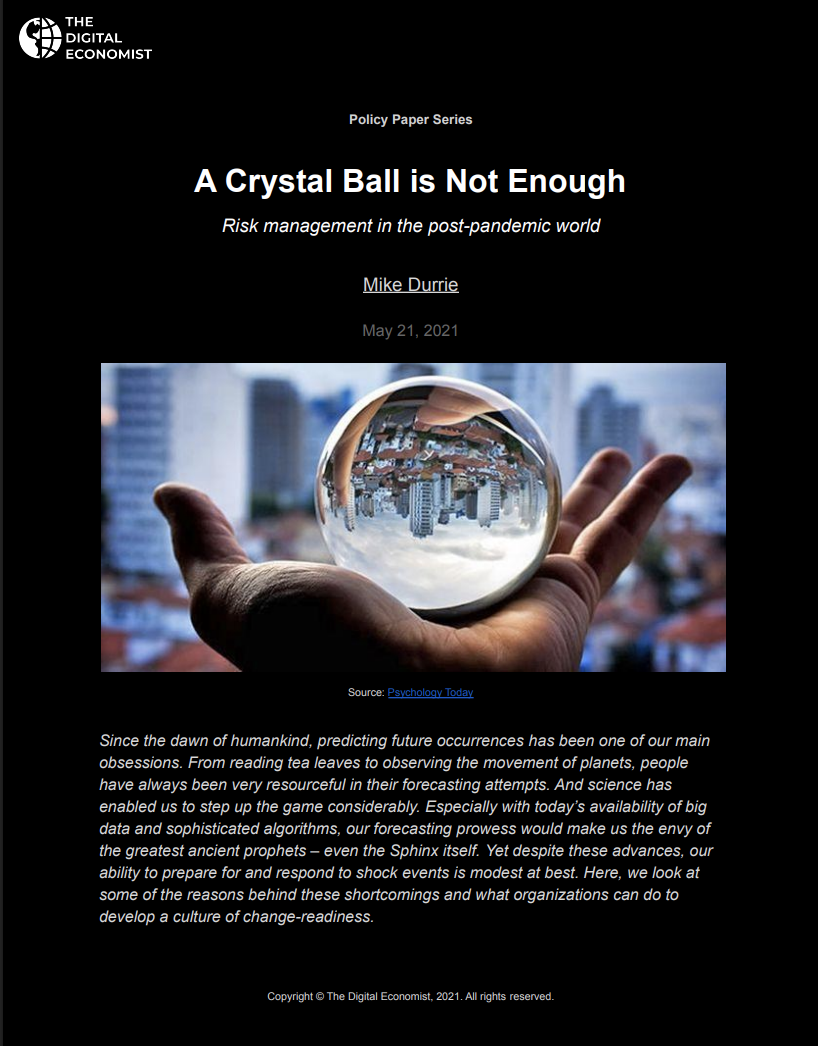
Advances in data, modeling, and forecasting have significantly improved our ability to anticipate future events—but they have not translated into effective preparedness for systemic shocks. A Crystal Ball is Not Enough examines the limitations of predictive capabilities in the context of the COVID-19 pandemic, highlighting how known risks—such as global pandemics—were extensively studied and anticipated, yet insufficiently acted upon. The paper argues that the central challenge is not a lack of foresight, but a failure to translate knowledge into agile, coordinated responses within complex global systems.
The paper analyzes the structural trade-offs embedded in modern economic and organizational systems, particularly the prioritization of efficiency and cost optimization over resilience and adaptability. It demonstrates how global supply chains, designed for maximum efficiency through lean production and just-in-time delivery, proved unable to respond quickly to sudden surges in demand—such as shortages of personal protective equipment during the pandemic. The analysis further explores how increasing systemic complexity, driven by intersecting megatrends such as urbanization, digitalization, and climate change, amplifies both the frequency and impact of disruptive events. In this context, the ability to respond rapidly and effectively becomes as critical as the ability to predict.
The paper outlines a strategic framework for building “change-readiness” as a core organizational capability. It emphasizes the importance of developing parallel systems that can be activated in times of disruption, alongside cultivating organizational cultures that support flexibility and rapid adaptation. Drawing on established cultural frameworks, the paper highlights how values and behaviors—rather than underlying assumptions—must evolve to enable agile responses. Ultimately, it positions resilience not as a byproduct of prediction, but as a function of preparedness, cultural alignment, and the capacity to respond dynamically to an increasingly uncertain and complex world.