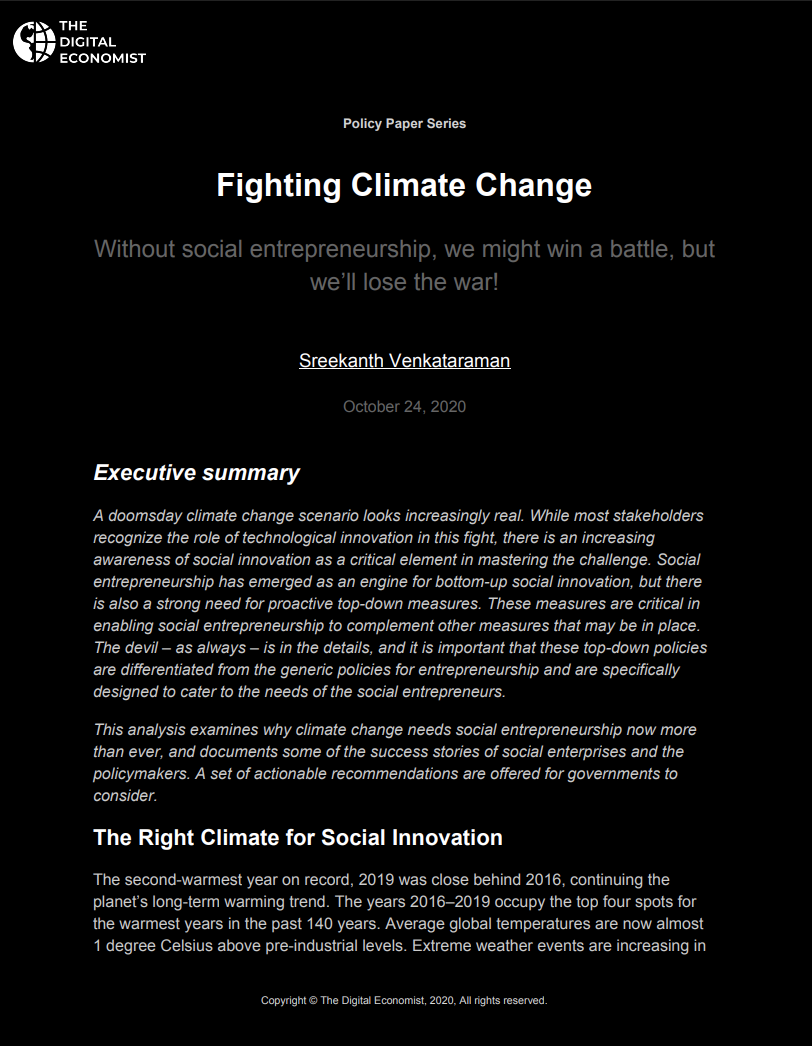
Climate change is accelerating toward increasingly severe and irreversible outcomes, with rising global temperatures and more frequent extreme weather events underscoring the urgency of coordinated action. Fighting Climate Change argues that while technological innovation remains essential, it is insufficient on its own to address the scale and complexity of the crisis. The paper positions social entrepreneurship as a critical, yet underutilized, driver of climate solutions—enabling bottom-up innovation that complements traditional top-down policy approaches and aligns with global frameworks such as the Paris Agreement and the United Nations Sustainable Development Goals.
The paper examines how social innovation operates as a catalyst for both environmental and societal impact, emphasizing its role in addressing the interconnected challenges of climate change, poverty, and inequality. It highlights how vulnerable populations—particularly those at the base of the socioeconomic pyramid—are disproportionately affected by climate risks, creating a reinforcing cycle of environmental and economic disadvantage. Through case-based examples, the analysis demonstrates how social enterprises leverage digital technologies such as artificial intelligence, blockchain, and platform-based systems to deliver scalable, community-driven solutions—from incentivizing sustainable behavior to improving agricultural supply chains and enabling energy efficiency markets.
The paper outlines a policy agenda to strengthen the social entrepreneurship ecosystem as a core component of climate strategy. It calls for targeted government support, differentiated regulatory frameworks, expanded access to funding, and the integration of social entrepreneurship into education systems. Additional recommendations include the development of specialized incubators, training programs in emerging technologies, and incentives for private sector participation through corporate social responsibility initiatives. Ultimately, the paper positions social entrepreneurship as a necessary force multiplier in the fight against climate change—one that can bridge gaps between policy, technology, and community action to deliver more inclusive, resilient, and sustainable outcomes.