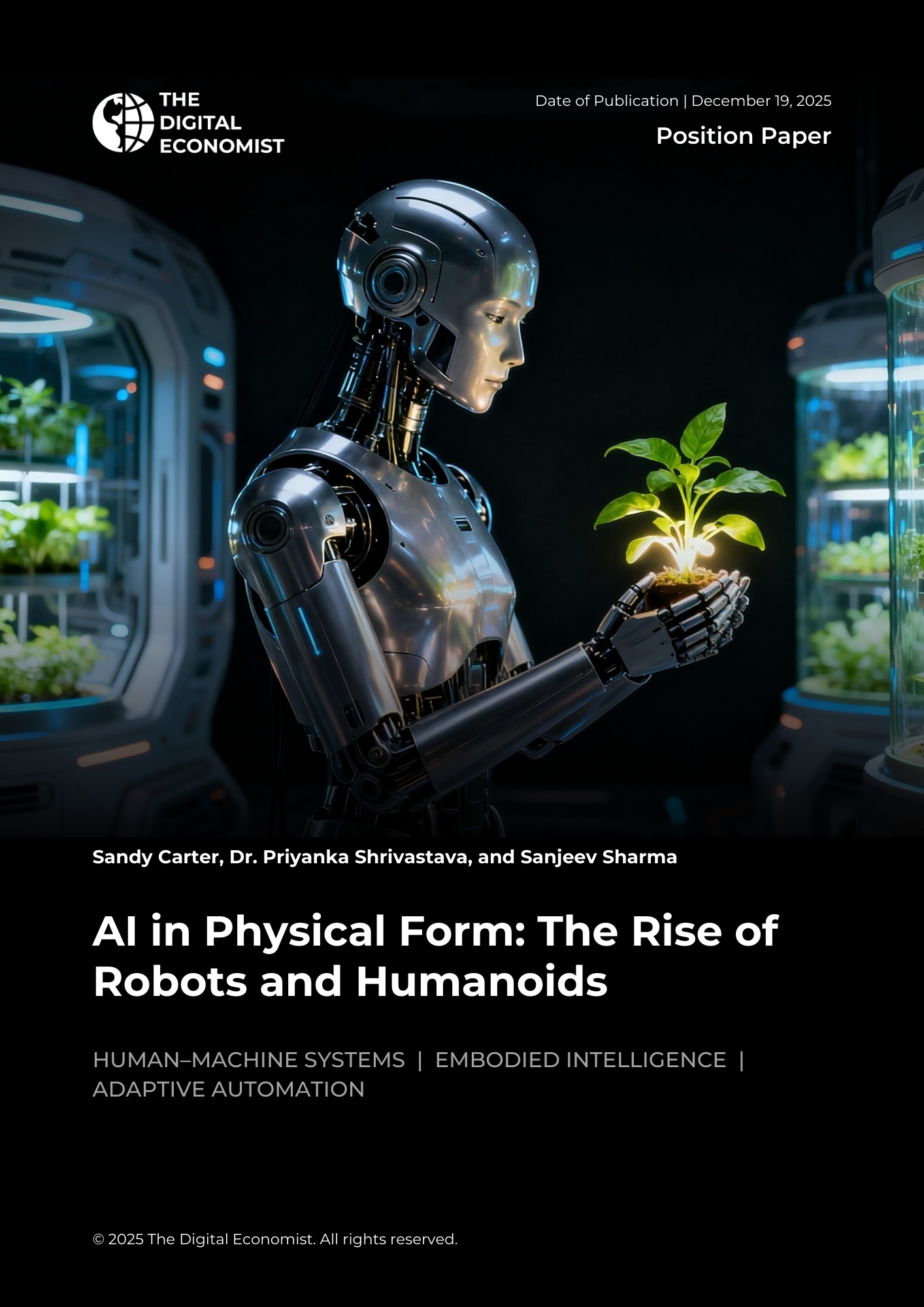
This position paper examines the rise of physical and embodied AI—robots and humanoids capable of perceiving, deciding, and acting in the real world—and the implications of this shift for industry, labor, and society. It shows how these systems are already delivering measurable gains in safety, consistency, and operational resilience across logistics and manufacturing, with expanding applications in elder care, field service, construction, and other human-centered environments.
Drawing on market analysis, technology architecture, case studies, and a governance-oriented Physical AI Flywheel, the paper provides leaders with a practical framework for responsible adoption. It addresses not only economic efficiency and new capabilities but also the associated risks, including safety incidents, workforce disruption, privacy exposure, and unclear accountability. Framing embodied AI as a long-term platform rather than a short-term automation fix, the paper offers guidance on where to start, how to design with workers in mind, how to align with global standards, and how to measure impact with the same rigor applied to enterprise digital transformation.





















.jpg)
.jpg)
.jpg)
.png)