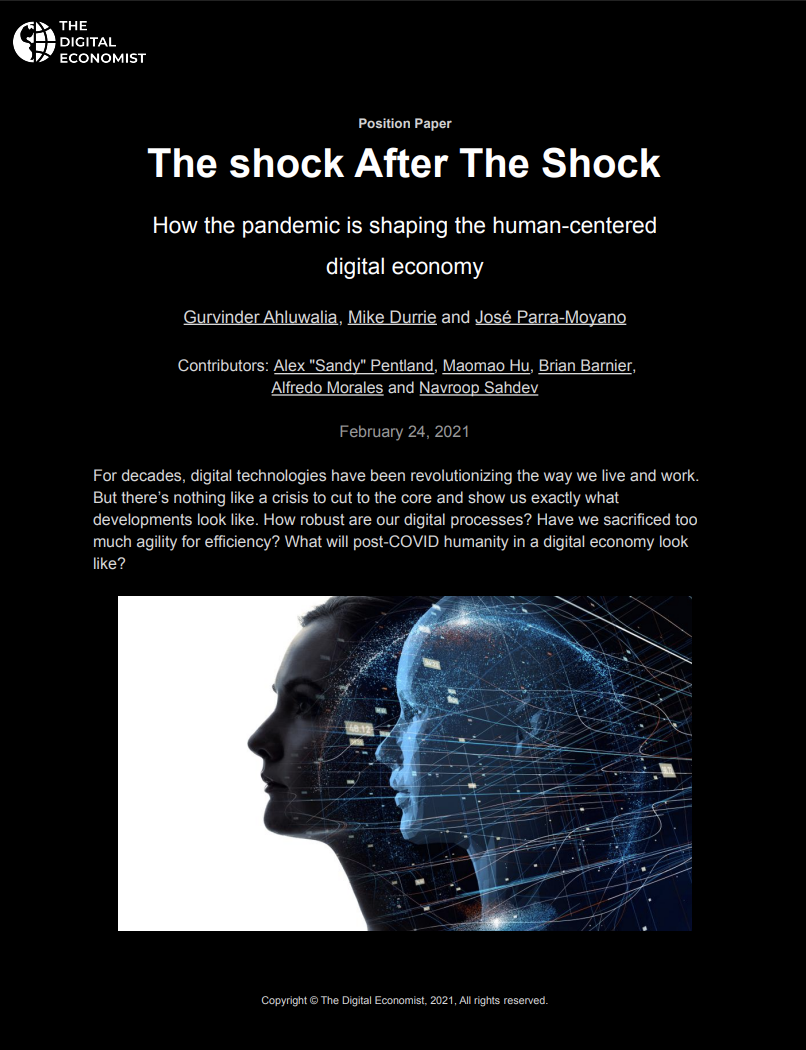
The COVID-19 pandemic has exposed both the fragility of physical systems and the resilience of digital infrastructures, accelerating a structural shift toward a human-centered digital economy. The Shock After The Shock examines how the crisis has acted as a stress test for global systems, revealing the strengths of digital technologies in enabling continuity—from remote work and communication to online commerce and services—while also highlighting the limitations of efficiency-driven models that lack adaptability. The paper frames this moment as a turning point, where the challenge is not simply recovery, but the deliberate redesign of economic systems to be more resilient, inclusive, and responsive to disruption.
The paper analyzes three foundational characteristics shaping the emerging digital economy. First, it emphasizes antifragility—systems that not only withstand shocks but improve under stress, as demonstrated by scalable digital platforms and distributed infrastructures. Second, it introduces the concept of a self-organizing system of systems, where interconnected digital services, economic flows, and societal interactions dynamically adapt across geographies and sectors. Third, it highlights the importance of incremental, iterative development models, where continuous improvement and rapid deployment enable innovation to evolve in real time. The analysis also examines the central role of data as both a driver of value and a source of risk, outlining the “privacy paradox” and exploring emerging models such as data cooperatives and exchanges that aim to balance utility with individual agency.
The paper outlines a forward-looking blueprint for a human-centered digital economy, structured as an integrated portfolio spanning automated, presence-based, physical, and person-centric economic activities. It calls for systems that are accessible, privacy-preserving, and designed to empower individuals while supporting broader societal and environmental outcomes. Ultimately, the paper positions the post-pandemic transition as an opportunity to move beyond reactive adaptation toward intentional system design—one that aligns technological advancement with human agency, economic resilience, and planetary sustainability.