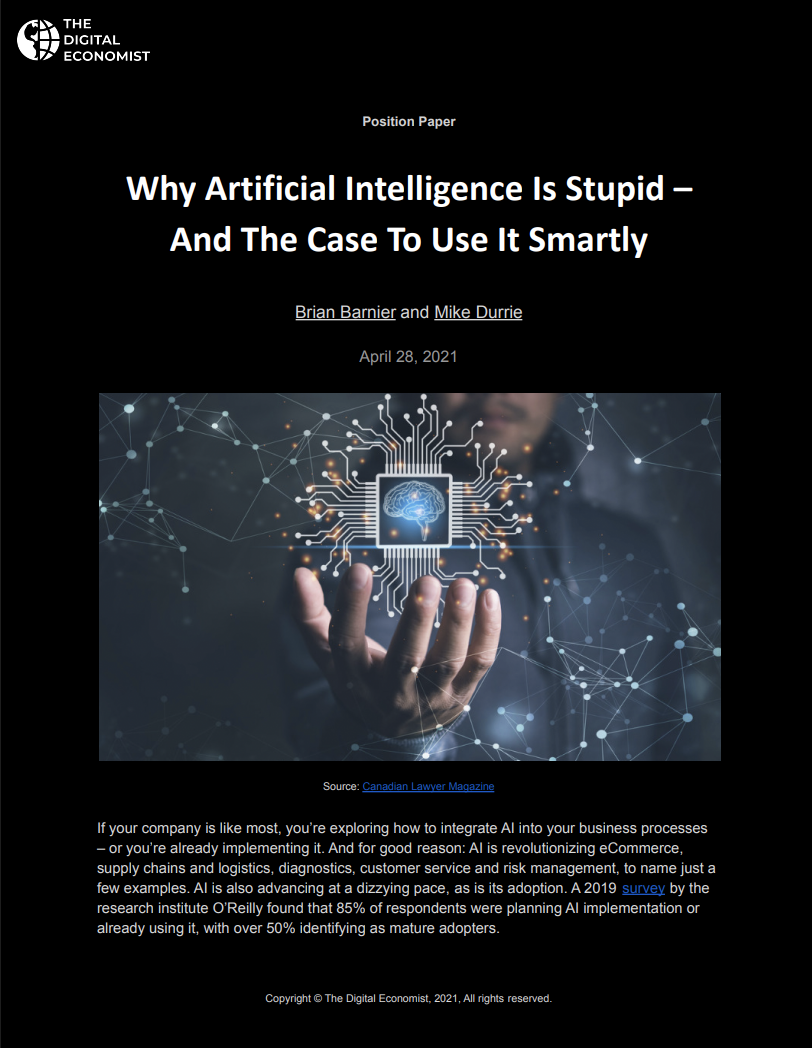
Artificial intelligence is rapidly transforming industries, yet its capabilities are often misunderstood and overestimated. Why Artificial Intelligence Is Stupid – And The Case To Use It Smartly examines the paradox at the heart of AI: while it can deliver powerful results in well-defined, data-rich environments, it remains fundamentally limited in its ability to replicate human intelligence. The paper challenges the assumption that AI should be universally applied, arguing instead that its value depends on a precise understanding of where it works—and where it does not.
The paper explores how machine learning systems operate through pattern recognition within constrained parameters, distinguishing between supervised, unsupervised, and reinforcement learning approaches. It highlights that AI performs best in contexts with clear rules, abundant labeled data, and stable causal relationships—such as image recognition, translation, and certain medical diagnostics. However, it also demonstrates how AI can fail when these conditions are absent, producing misleading or spurious correlations, as illustrated by cases where algorithms misinterpret contextual signals or reinforce hidden biases. The analysis further underscores risks in business applications, including flawed decision-making, ethical concerns in areas such as hiring, and overreliance on opaque “black box” systems.
The paper outlines a disciplined approach to AI adoption, emphasizing the need for rigorous problem definition, system understanding, and validation before implementation. It calls for the use of AI as an augmentative tool rather than a standalone decision-maker, supported by cross-functional expertise and structured evaluation frameworks such as hazard avoidance assessments. Ultimately, the paper positions AI not as a universal solution, but as a specialized instrument—one that can deliver significant value when applied strategically, but that requires critical oversight, contextual awareness, and human judgment to avoid costly and potentially harmful outcomes.