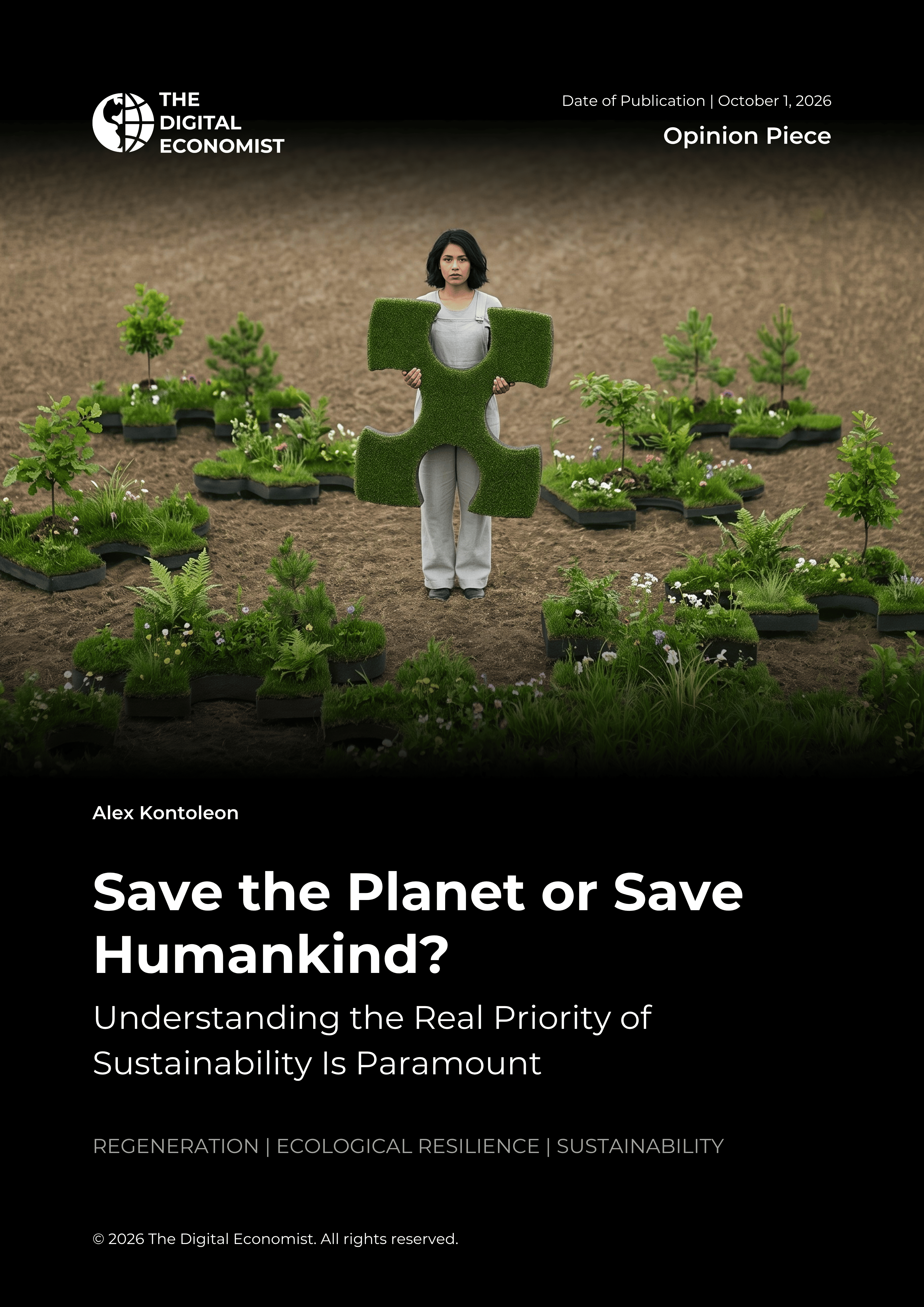
Save the Planet or Save Humankind? examines the paradox at the heart of modern sustainability: humanity has achieved unprecedented levels of prosperity, longevity, and technological advancement, yet these gains have come at an increasing ecological cost. The paper explores why decades of sustainability efforts have struggled to reverse environmental degradation and argues that the challenge may lie not only in what we are doing, but in how we have framed the problem.
The paper examines the assumptions underlying conventional sustainability thinking, including the tendency to view environmental decline through a linear, extractive model of resource use. Drawing on the planetary boundaries framework, regenerative economics, ecological systems thinking, and research on circular and nature-positive approaches, it explores the distinction between sustaining existing systems and actively regenerating the conditions that support human prosperity. It argues that the planet itself does not need to be “saved”; rather, the focus should be on maintaining the ecological conditions that make human life, abundance, and continued prosperity possible.
The paper ultimately calls for a new alignment between economic activity and the regenerative processes of the natural world. Rather than framing sustainability as a moral obligation or a choice between prosperity and the planet, it positions regeneration as the next evolution of sustainability—one that aligns economic incentives, long-term resilience, and human prosperity with the ecological systems on which they depend.













.png)